Short serve forward entry — Pass-to-attack continuity
Start behind the three-metre line and attack the short ball into zone 3 without lunging on the last step.
Applied training constraint: After reception, run a set and controlled attack so the target is a usable second contact.
Your exercise in three steps
Short serve forward entry — Pass-to-attack continuity
Three vector instruction panels for offline use. The reference photograph is not included.
Static training layout
Schematic player positions and ball path, not a staged photograph.
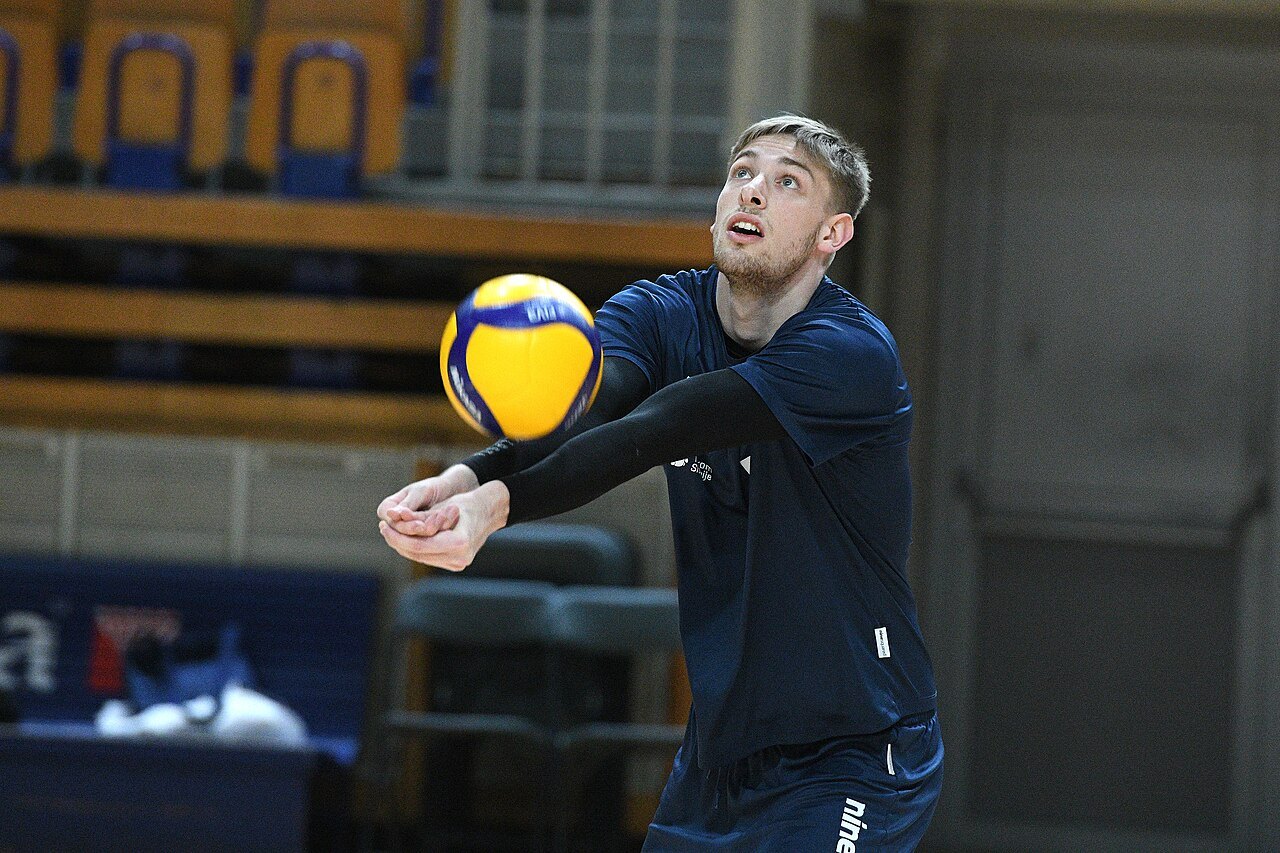
Action reference photograph
Authentic credited technique-family reference; never presented as the exact custom drill.
Short serve forward entry
Split, step, stop and angle the shoulders toward target.
Start behind the three-metre line and attack the short ball into zone 3 without lunging on the last step.
Equipment: Volleyballs, Setter target, Floor markers
Starting zone: 3
- Start behind the three-metre line and attack the short ball into zone 3 without lunging on the last step.
- After reception, run a set and controlled attack so the target is a usable second contact.
- Split, step, stop and angle the shoulders toward target.
- Log each repetition according to this measure: Count a completed side-out only when reception and attack are both controlled.
21 minutes
10 balls in the starting series, with rest adjusted to quality and player level.
Count a completed side-out only when reception and attack are both controlled.
Record attempts, success and errors; do not infer progress from volume alone.
Scale workload, speed and distance to ability; stop whenever execution or safety deteriorates.
Measure learning, not just count drills
Target: Count a completed side-out only when reception and attack are both controlled.
Suggested starting set: 10 repetitions; adjust for level and safety.
Attempts
Target hits
Playable
Target success rate
Saved only in this browser on this device. Account synchronization is not active yet.
Next drill condition for this movement
Each protocol identifies the core movement and the changed practice constraint.